Safety doesn't have to come with a price tag. In high-risk environments—from construction sites to manufacturing floors—daily awareness can mean the difference between a routine shift and a preventable injury. Yet many teams still skip safety briefings, not because they don’t care, but because they assume creating or accessing effective content is time-consuming or expensive. The reality? High-quality, free online toolbox talks are widely available and designed for real-world use.
These short, focused safety discussions—typically 5 to 15 minutes—cover specific hazards, procedures, or best practices relevant to current job tasks. When delivered consistently, they reinforce safety culture, reduce incidents, and support compliance with OSHA and other safety standards. And the best part: you don’t need a budget to run them effectively.
Here’s how to find, use, and optimize free online toolbox talks—without sacrificing quality or relevance.
Why Free Online Toolbox Talks Are a Game-Changer
Toolbox talks are most effective when they’re timely, relevant, and conversational. Free online resources make this possible even for lean teams or solo supervisors who lack dedicated safety personnel.
Consider this: a roofing crew preparing for high-wind work doesn’t need a generic fall protection lecture—they need a targeted discussion on securing materials, harness use in gusty conditions, and emergency response if something shifts. Free online toolbox talks often include these niche topics, downloadable in PDF or editable formats, ready for immediate use.
They’re especially valuable for: - Small contractors without formal safety programs - Supervisors needing last-minute content before a shift - Companies scaling operations across multiple sites - Multilingual crews needing translated versions
The barrier to entry has never been lower. But not all free content is created equal.
How to Evaluate Quality in Free Toolbox Talks
Just because it’s free doesn’t mean it’s useful. Many templates found online are outdated, overly generic, or poorly structured. To avoid wasting time on subpar content, look for these indicators of quality:
1. Topic Specificity Avoid titles like “General Safety.” Instead, opt for talks like “Using Ladders on Unstable Ground” or “Preventing Heat Stress During Summer Shifts.” Specificity increases engagement and retention.
2. Clear Structure A strong toolbox talk includes: - A brief hazard overview - Real-world scenarios (“What could go wrong?”) - Prevention strategies - Discussion prompts for team interaction - Space for signatures or attendance logs
3. Regulatory Alignment Check if the content references OSHA standards (e.g., 29 CFR 1926 for construction) or industry best practices like ANSI or NFPA. This ensures relevance and helps during audits.
4. Editable Formats PDFs are convenient, but Word or Google Docs formats let you customize talks for your site’s risks, equipment, or procedures.
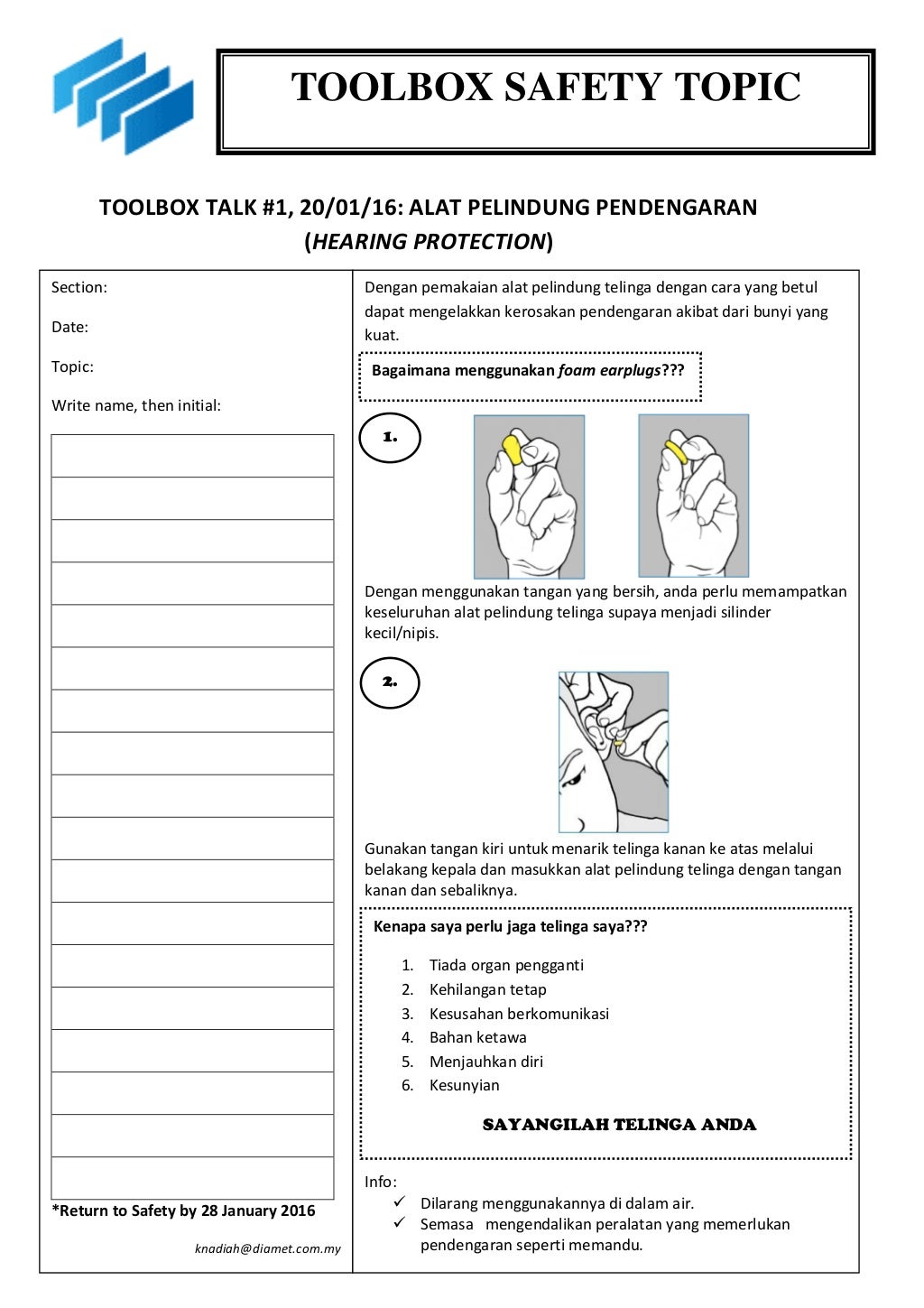
5. Visual Aids Diagrams, photos, or simple illustrations help clarify complex points—especially for teams with mixed literacy levels or language backgrounds.
A red flag? If the talk ends with “Stay safe!” and nothing else, it’s likely filler. Real safety conversations require substance.
Top 5 Sources for Free Online Toolbox Talks
Not all providers are equal. Here are five trusted sources offering genuinely useful, no-cost toolbox talks—without requiring email signups or hidden fees.
| Source | Topics Covered | Format | Key Features |
|---|---|---|---|
| OSHA.gov | Fall protection, PPE, electrical safety, trenching | PDF, printable | Official, regulation-aligned, minimal jargon |
| SafetyInfo.com | Construction, warehouse, equipment operation | PDF, editable | Veteran-created, real-world tested |
| NIOSH (CDC) | Ergonomics, chemical exposure, fatigue | PDF, fact sheets | Science-backed, research-informed |
| ConstructionSafetyTips.org | Scaffolding, crane safety, confined spaces | PDF, bilingual options | Industry-specific, visual-heavy |
| SafeStart.com | Human factors, situational awareness, near misses | PDF, discussion guides | Behavior-based, promotes engagement |
Each of these platforms offers ready-to-use content that’s been vetted by safety professionals. OSHA’s site, for example, includes talks directly pulled from compliance guidelines—ideal for audit prep. SafetyInfo, founded by a former safety director, includes editable templates that allow supervisors to insert company policies or site conditions.
For multilingual crews, ConstructionSafetyTips.org provides select talks in Spanish—critical for comprehension and inclusion.
How to Customize Generic Talks for Real Impact
A downloaded template is just the starting point. To make a toolbox talk stick, you must localize it.
Example: You download a free “Eye Protection” talk from NIOSH. It covers basics like wearing safety glasses and chemical splash risks. But your team works with angle grinders daily.
Here’s how to adapt it: - Add a photo from your own site showing proper vs. improper eye protection - Mention the specific grinder model they use - Reference a near miss from last month where debris flew near someone’s face - Ask: “What would you do if your goggle strap broke mid-task?”
This turns a theoretical discussion into a lived experience.
Customization checklist: - Replace generic examples with site-specific scenarios - Insert your company name, logo, and safety policy references - Translate critical terms if needed - Add photos or sketches from your worksite - Include a sign-in sheet with employee names and roles
A 10-minute edit can double the talk’s effectiveness.
Common Mistakes That Undermine Safety Talks
Even with great content, delivery matters. These common pitfalls sabotage engagement:
1. Reading Aloud Word-for-Word Toolbox talks aren’t lectures. If you’re just reciting text, eyes will glaze over. Use the document as a guide—not a script.
2. Skipping the Discussion The most valuable part isn’t the handout—it’s the conversation. Ask open-ended questions: “Have you seen this hazard before?” or “What would you do differently?”
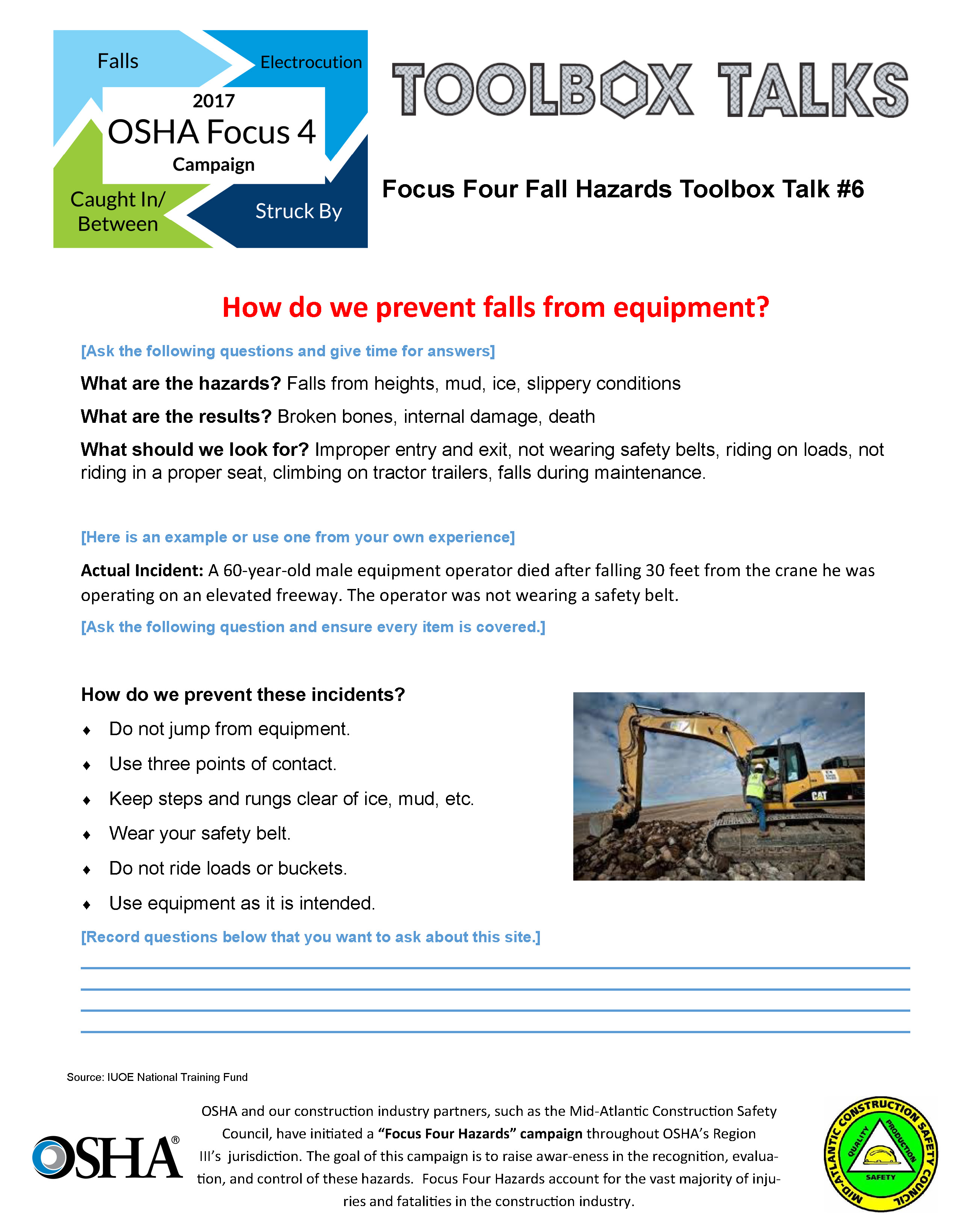
3. Holding Talks Indoors or Off-Site Conduct the talk where the work happens. Standing next to scaffolding makes fall protection feel real. In a break room, it feels abstract.
4. Inconsistent Frequency Weekly or biweekly isn’t enough. High-risk sites need daily talks—especially when conditions change (weather, new equipment, shift changes).
5. No Follow-Up Did the talk lead to behavior change? Did someone report a hazard afterward? Track outcomes informally. If nothing changes, reassess your approach.
Remember: a toolbox talk that isn’t discussed is just a memo.
Integrating Free Toolbox Talks Into Your Safety Workflow
The best programs treat these talks as part of a continuous cycle—not a box-ticking exercise.
- Daily 10-Minute Routine:
- Select topic based on that day’s work (e.g., “Working Near Excavations”)
- Pull free talk from OSHA or SafetyInfo
- Customize with a real example from your site
- Gather crew at the work location
- Facilitate discussion—ask questions, encourage stories
- Sign and file attendance sheet
- Note observations (e.g., “Crew raised concern about ladder stability”)
This takes less than 15 minutes but builds awareness, accountability, and trust.
Some teams go further by rotating talk facilitation among crew members. This boosts ownership and surfaces insights supervisors might miss.
Digital tip: Store talks in a shared folder labeled by month and topic. Use Google Drive or a simple USB drive on-site. No software needed.
Real-World Use Cases That Work
Case 1: Residential Roofing Crew After a close call with a slipping worker, the foreman pulled a free “Fall Protection on Low-Slope Roofs” talk from ConstructionSafetyTips.org. He added a photo of their current job site and asked each worker to describe their harness check routine. Two workers admitted they’d skipped anchoring that morning—prompting an immediate refresher.
Case 2: Warehouse Night Shift A new hire almost walked into a forklift blind spot. The supervisor used a NIOSH talk on “Pedestrian Safety Around Equipment,” held it at the loading dock, and had drivers demonstrate horn use and backup alarms. Crew now uses hand signals consistently.
Case 3: Municipal Road Crew During winter, a free “Cold Stress Awareness” talk from OSHA was customized with local weather reports and break schedules. Workers started monitoring each other for shivering or slurred speech—leading to an early intervention for hypothermia.
In each case, free content became a catalyst for real behavioral change.
Make Safety Accessible, Not Optional
Free online toolbox talks aren’t a shortcut—they’re a tool. Their value isn’t in being cost-free, but in being usable, adjustable, and practical. The best safety programs don’t rely on expensive platforms or consultants. They rely on consistent, honest conversations—fueled by resources anyone can access.
Start today: pick one high-risk task your team performs regularly. Find a free talk on that topic. Read it, adapt it, and discuss it with your crew where the work happens. No login. No trial period. No excuses.
Safety isn’t about perfection. It’s about showing up—and talking about what matters.
FAQ
What should you look for in Free Online Toolbox Talks for Safer Workplaces? Focus on relevance, practical value, and how well the solution matches real user intent.
Is Free Online Toolbox Talks for Safer Workplaces suitable for beginners? That depends on the workflow, but a clear step-by-step approach usually makes it easier to start.
How do you compare options around Free Online Toolbox Talks for Safer Workplaces? Compare features, trust signals, limitations, pricing, and ease of implementation.
What mistakes should you avoid? Avoid generic choices, weak validation, and decisions based only on marketing claims.
What is the next best step? Shortlist the most relevant options, validate them quickly, and refine from real-world results.