Every year, preventable accidents occur during equipment maintenance because energy sources aren’t properly isolated. The root cause? A missing or misused lockout tagout (LOTO) system. Lockout tagout boards and locks aren’t just accessories in a safety program—they’re the backbone of hazard control in industrial settings. From manufacturing plants to commercial facilities, the right LOTO setup ensures machines stay de-energized during service, protecting workers from electrocution, crushing, and unexpected startups.
OSHA estimates that proper lockout tagout procedures prevent 120 fatalities and 50,000 injuries annually. Yet, non-compliance remains widespread. One of the most common failures? Poor organization and execution of lockout devices—specifically, the misuse or absence of structured lockout tagout boards and standardized locks. This article breaks down what makes LOTO boards and locks effective, how to select and deploy them, and the real-world impact of getting it right.
Why Lockout Tagout Boards Are Mission-Critical
A lockout tagout board is more than a storage rack—it’s a visual control system. Its primary function is to centralize locks, tags, keys, and procedures so that authorized employees can implement energy isolation quickly and correctly. Without it, critical LOTO equipment gets lost, misused, or bypassed during high-pressure maintenance windows.
Consider this scenario: A technician must service a conveyor belt system. Without a board, locks are scattered across toolboxes, tags are missing, and accountability is unclear. The result? Someone may energize the system prematurely, leading to catastrophic injury.
A well-designed LOTO board solves this by:
- Assigning individualized lock stations
- Providing clear visual cues (color-coded zones, labels)
- Holding standardized tags and procedural checklists
- Ensuring all required locks are accounted for before re-energization
In regulated environments like food processing or automotive assembly, these boards are audited regularly. Their absence or disorganization can trigger OSHA citations—even if no incident occurred.
Types of Lockout Tagout Boards: Matching Design to Workflow
Not all LOTO boards are created equal. The best ones align with your facility’s machinery, workforce size, and maintenance complexity. Here are the most effective types in the field today:
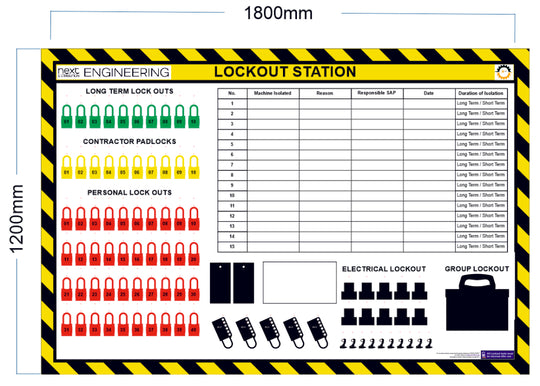
#### 1. Wall-Mounted Master Station Boards These are the most common. They feature individual lock stations (often labeled with employee names or IDs), tag storage, and space for procedure sheets. Ideal for facilities with multiple maintenance teams.
Best for: Medium to large industrial sites with rotating shifts. Example: A paper mill uses color-coded zones—red for electrical, blue for hydraulic—so technicians instantly know which locks belong where.
#### 2. Portable Lockout Kits Compact, wheeled units that bring the board to the machine. Useful in decentralized operations where equipment is spread out.
Best for: Facilities with remote or outdoor machinery (e.g., water treatment plants). Limitation: Less secure than fixed installations; must be locked when unattended.
#### 3. Digital Smart Boards Equipped with RFID tracking, digital logs, and real-time status updates. These integrate with CMMS (Computerized Maintenance Management Systems) for audit trails.
Best for: High-compliance environments like pharmaceuticals or aerospace. Example: A technician scans their badge, removes their personal lock station, and the system logs the action, reducing paperwork and increasing traceability.
While smart boards offer automation, many facilities still rely on mechanical boards due to cost and simplicity. The key is choosing a design that supports—not complicates—your team’s workflow.
Lockout Locks: Beyond the Padlock
Lockout locks are the physical enforcement mechanism of energy control. But not every padlock will do. Standard hardware-store locks fail under industrial conditions or can be easily duplicated—both major safety risks.
Effective lockout locks must meet three criteria:
- Non-conductive: Made from polymer or laminated steel to prevent electrical conductivity.
- Key-retaining: The key can only be removed when the lock is closed—preventing accidental unlocking.
- Unique keying: Each worker should have a personally assigned lock with a distinct key. No master keys allowed during active lockout.
Common lock types include:
- Hasp locks: Used with multi-energy sources. Allow multiple workers to apply their locks to a single isolation point.
- Valve lockouts: Fit over gate or ball valves to prevent reactivation.
- Circuit breaker lockouts: Clamp over breakers to block re-energizing.
- Plug lockouts: Cover electrical plugs to prevent reconnection.
A frequent mistake? Using combination locks. While convenient, they undermine personal accountability—anyone who knows the code can remove the lock. OSHA’s LOTO standard (29 CFR 1910.147) emphasizes individual control, meaning each worker must apply and remove their own lock. Shared access defeats the purpose.
Common Mistakes That Undermine LOTO Programs
Even facilities with boards and locks in place often fall short due to preventable errors. Here are the most damaging:
- Using generic tags without specifics: Tags that say “Do Not Operate” without naming the person, date, or equipment are ineffective. Always use tags with fields for all required details.
- Storing locks off-board: If locks live in personal toolboxes, they’re not part of the controlled system. Centralized storage ensures visibility and accountability.
- Skipping group lockout procedures: In team maintenance, only one lead worker should coordinate lock application and removal. Failure to designate a leader leads to confusion.
- Lack of training updates: Workers trained five years ago may forget procedures. Refresher training every 12 months is OSHA-recommended.
- Ignoring isolation points: Some machines have multiple energy sources (electrical, pneumatic, hydraulic). Each must be locked out separately.
One plant reduced LOTO-related near-misses by 78% simply by mandating weekly board audits and adding laminated procedure cards to each station.
Real-World Use Cases: How Boards and Locks Prevent Disasters

#### Case 1: Automotive Assembly Line A technician was repairing a robotic arm. The lockout board had 8 assigned stations. Each team member applied their lock before work began. A supervisor verified all locks were in place using the board’s checklist. During re-energization, one lock remained—triggering a pause. Investigation revealed a second technician hadn’t finished. The board prevented a startup that could have caused severe injury.
#### Case 2: Chemical Processing Plant Workers needed to unclog a pressurized pipe. The facility used a portable LOTO kit with color-coded tags. The red tag indicated high-pressure hazard, and the board required dual verification before removal. This layered approach stopped a junior technician from unlocking the system prematurely.
These cases show that success isn’t just about having locks—it’s about integrating them into a visible, accountable system.
Top 5 Lockout Tagout Board and Lock Systems
Here are five widely trusted systems used across industries:
| System | Key Features | Best For |
|---|---|---|
| Grace Industries LOTO Master Station | 20-lock capacity, customizable labels, durable steel | Large teams, high-volume maintenance |
| Stanley Heavy-Duty Valve Lockout Kit | Includes polymer locks, tags, hasps, and valve covers | Field maintenance, oil and gas |
| Safeguard Equipment SmartLOTO Board | RFID tracking, digital logs, CMMS integration | Regulated industries, data compliance |
| Master Lock 1400DAT Series | Key-retaining padlocks, non-conductive bodies, variety of colors | General industrial use |
| Bernard Technologies Portable Lockout Cart | Mobile unit with storage, built-in checklist, weather-resistant | Outdoor or decentralized operations |
When selecting a system, prioritize durability, scalability, and ease of integration with existing safety protocols.
Building a Compliant, Effective LOTO Workflow
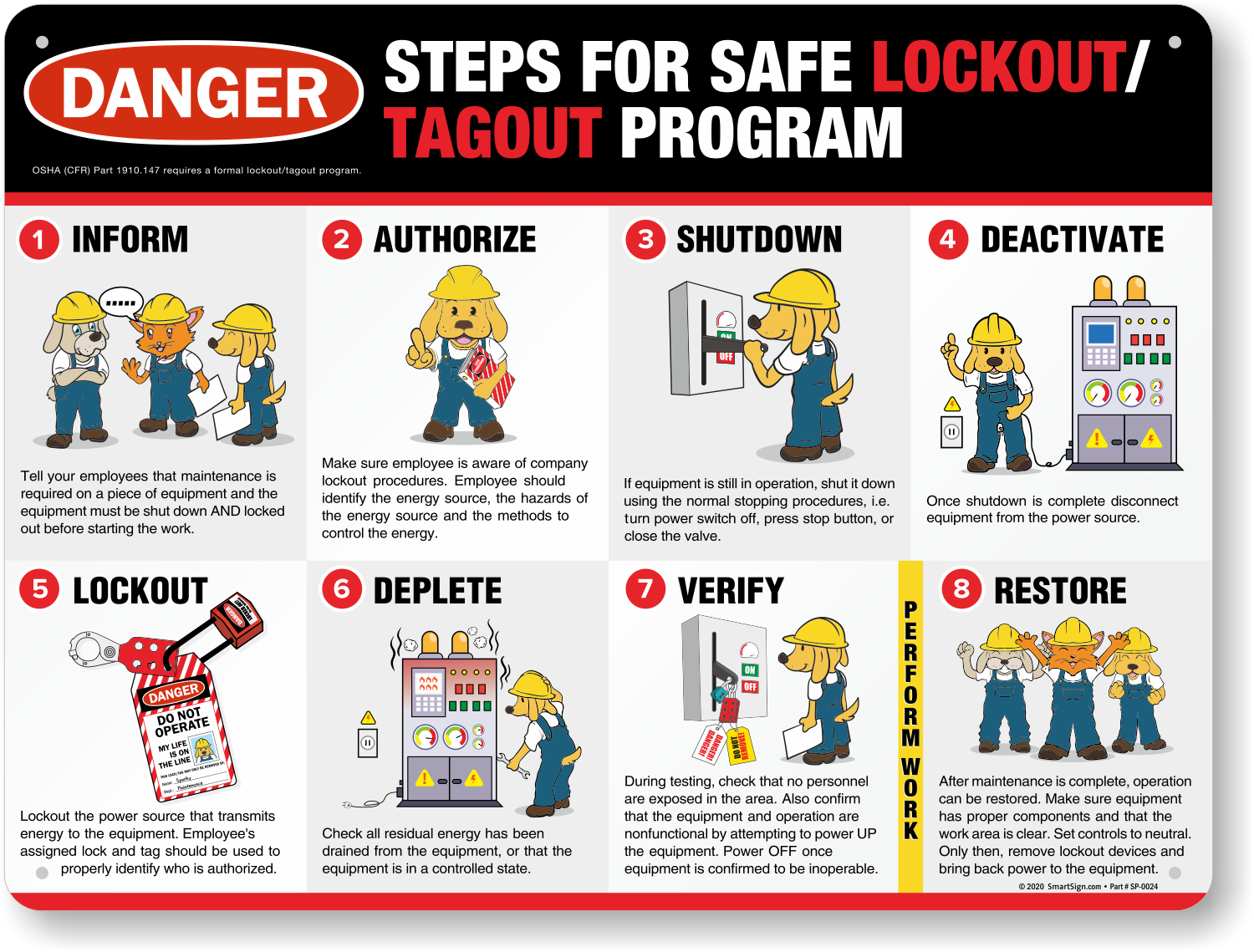
A successful lockout program isn’t just about hardware—it’s about habits. Use this streamlined workflow:
- Preparation: Identify all energy sources and isolation points.
- Notification: Inform affected employees that lockout will begin.
- Shutdown: Turn off equipment using normal controls.
- Isolation: Disconnect or block all energy sources.
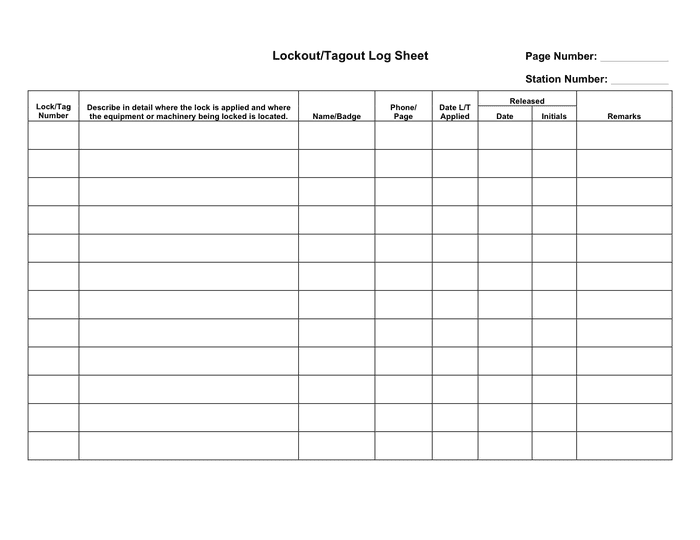
- LOTO Application: Each authorized worker applies their lock and tag to the board and equipment.
- Verification: Confirm zero energy state (test switches, pressure gauges).
- Maintenance: Perform the service task.
- Removal: Only the individual who applied the lock removes it. Supervisor confirms all locks are off before re-energizing.
The board plays a role at every stage—from holding procedure cards to tracking lock status. Make it the centerpiece of your energy control process.
Final Thoughts: Don’t Treat LOTO as a Checkbox
Lockout tagout boards and locks aren’t compliance decor. They’re engineered safeguards that demand respect, consistency, and proper use. Investing in a well-designed board, high-quality locks, and ongoing training isn’t just about avoiding OSHA fines—it’s about protecting lives.
Start by auditing your current setup. Are locks centralized? Are tags complete? Is the board visible and accessible during maintenance? Fix the gaps. Train your team. Then test the system under real conditions.
Because when a machine powers on unexpectedly, the difference between safety and tragedy is often one missing lock—and the board that should have held it.
FAQ
What should you look for in Lockout Tagout Boards and Locks: Your Safety Backbone? Focus on relevance, practical value, and how well the solution matches real user intent.
Is Lockout Tagout Boards and Locks: Your Safety Backbone suitable for beginners? That depends on the workflow, but a clear step-by-step approach usually makes it easier to start.
How do you compare options around Lockout Tagout Boards and Locks: Your Safety Backbone? Compare features, trust signals, limitations, pricing, and ease of implementation.
What mistakes should you avoid? Avoid generic choices, weak validation, and decisions based only on marketing claims.
What is the next best step? Shortlist the most relevant options, validate them quickly, and refine from real-world results.